To refine the posters further, we worked on fixing all the levels of hierarchy we had last time because of the colors (the bright yellow really popping out) as well as some scaling issues that I had. On to the final!
Here is the next iteration of the research posters. We took some time to comb through the type and edit a lot of it down, trying to avoid large, dense masses of text. For this new version, we also added a lot more of the hand-rendered type, although it could still use some refinements. Still, the idea is there! While working on this, we are trying to keep an eye on both our research and our mood board, so to make sure that it accurately reflects our audience!
This is the first draft of the research poster. Lots of dots and lots of text. But the hand-rendered text is nice, thanks to Brandon! I am working on the individual side while he manages the community half. Meet Charlie and Eyelyn, middle-schoolers in a classroom crossover!
So here are some of the initial thoughts that I had, after floundering around with the name for too long. Lots are really literal and pretty much just illustrate the early bird. Moving forward, I will make sure that not all three directions will feature a bird. Maybe just one, and I think the very top image is where I'm headed for that one.
Several decades ago, graphic design seemed to be much more simple, or at least more simply defined. There were perimeters that it stuck to and only a limited amount of media that it could be applied to. With the onset of computers however, that all has gone out the window. In many cases, it seems like graphic design is now a commodity, a vehicle, that often loses cohesion the more mediums one concept is spread across. Also, much of graphic design seems to now rely on someone's personal style. Many times the style is the end-all, when what we really need is a cohesive timeless solution to a problem—not just a pretty picture.
Now that we can do Anything
There has been a lot of innovation in the past few decades, more than there has been since the age of invention. When I read this, it was almost hard to believe, and it kind of blew my mind. But part of that might just be because it's something I grew up with, and therefor kind of gloss over. With the speedy change of the economies, and the sorts of services out there, it is important that graphic design is as up-to-date as the rest of what's out there. We are not just designers, but researchers and inventors, problem-solvers and presenters of information on all levels.
And designers are also not just those who design graphically. Nowadays, a designer is anyone that uses critical thinking to solve a problem. And we cannot discount these new designers, because design is now, more than ever, and extremely collaborative environment. Also, more and more of the systems that these other designers use can be manipulated to be used by us (again, collaboration!). Everyone is spilling into each others' respective fields, and it all sounds very exciting! The more that we can utilize these overlaps, the more ambitious we can be.
Cultural Catalysts, Cultural Agency
As a designer, it is our job to be a catalyst. We not only deliver the message, but also to create an environment or system in which we are not only informing the viewer (ie, to the existence of a product) but also providing the beginning of a dialogue between the client and the consumer. From there, the consumer has the opportunity to give their opinions and criticisms of the product, client can continue the dialogue, and trouble shooting can begin.
Quantum Leap: Beyond Literal Materiality
This reading was a little difficult for me to understand, I admit. What I think I got from it is: with the digital age, we need to modify our thinking to think past the previous physical limitations of what graphic design was. A toolbar in a program is not the same as a box of tools in real life. Do not think of what you are working on as a page, again, that it physical. Instead think of it i s a space, and a system. I was not really sure what this guy was getting at, eve after rereading this article.
Half Price Books
I chose to rebrand Half Price Books, a store
the resells books as well as CDs, records, movies, magazines, etc.
Currently HPB is seen by their audience as being an affordable, vast
collection of used books. But they are much much more than that, and
with their current branding, it is unfortunately not clear how big of a
role they play. Because of the scattered, cozy nature of their stores,
and their name containing the words “half-price,” they are currently
giving off a vibe that seems to be a little more “cheap” than it needs
to be. HPB is a wonderful company in the fact that they are
community-based and extremely invested in literacy, education, and green
movement programs. Unfortunately, these wonderful qualities are not
well reflected in their current branding, which is somewhat scattered
and off-track of their mission statement. My goal with this rebranding
is to update and enliven Half Price Books so that the emphasis of is
about their strong values rather than their affordable prices.
Since Taylor and Bethany and I are all working together, we decided to start off by looking in different directions.
To begin with, I continued my research regarding microfinancing from the previous class. Initially, I was stuck on the idea of implementing KIVA to raise money for what ever sort of center we end up trying to add. Personally, I love the idea of an affordable eating place for kids to gather and family to enjoy.
While looking at KIVA, I began to realize that it seemed to mostly offer loans to very VERY poor third world country people. So, against that, I don't know that KIVA was the best choice for Ivanhoe. I found another reputable microfinancing group, Grameen America. This is how they work:
IF we used this, we would have to use a group of people who would be willing to pull out a loan. And of course, whatever they ended up making into a business would have to be a for-profit establishment. If it were non-profit, then they would not be able to pay back the loan. But this is all still very rough.
Another element that I researched was the logistics of turning a home, in a residential area (the Ivanhoe Neighborhood Council owns a few) into a business. There are a couple things that would have to happen. First, we would need to contact the city and see if the house was zoned to be a business. If it were not zoned, we could apply for a conditional use permit. This is just an opinion, but I think that considering the location and the purpose of this community center, I think we might be able to argue the conditional use permit if it's not zoned for it!
For our visual audit and mood board, Brandon and I decided to turn them into one piece, because many of the bright colorful images for the audit side served as inspiration to us. Don't worry though, they are still separated, with the audit on the left and the mood board on the right.
Middle school/junior high school students are very in tune with popular culture, no matter what clique they fall into. They might be a Beiber fan, enjoy the peppy beats of Katy Perry, or perhaps spend their time keeping up to date with the latest television shows (adventure time is immensely popular among the artsy/fringe crowd).
Most of our target audience is consumed, one way or another, in their self image. This of course helps them relate with their friends and distinguish themselves as individuals.
Both social networking and mobile communications are detrimental to these kids. they never put down their phones, much to the frustration of their parents and teachers. Just like with their clothing and accessories, they use their facebook as a way to express themselves. They spend a lot of time editing their interests so that it reflects all they have in common with their friends.
They are of course young and fun! Middle schoolers, while very self conscious, also really put themselves out there for the sake of making friends and expressing themselves as being independent.
And of course there is the awkwardness.
As for the mood board, we tried to find things that both represented their young, bright personalities, while including a large variety to represent such a large crowd. I thought this was an interesting and cute little definition that at first appears scholarly, but then is actually something funny that middle schoolers can relate to.
We found many geometrical, brightly colored icons and images that reference some of the digital media that they use.
As for text, we found a variety of both digitally and hand-rendered examples that, again, speak to the youthful nature of the group. This rendering also reminded us of the doodlings that many students do on their notes and homework (of course this will not be rendered in quit as a juvenile manner).
Even though big companies will always dominate the market, it is increasingly common, and easy, to create and market our own products as an independent designer. Our job is no longer just to make a package, or an advertisement, or whatever. We can create whole experiences. With the resources available now, we can prototype our work and send it off to be created somewhere for a reasonable cost. We are now entrepreneurs, creating all elements of a product.
Birth of the User
Text is something that is more universal than icons, and it can cross the boundaries and limitations of language. In an screen-based experience, users are more interested in quick absorption of information rather than long periods of reflection time. It is all about being as quick and productive as possible. Of course, while they are using the web, there is also an opportunity for the designer to collect information from the users.
Graphic Authorship
In the past, graphic designers took their clients information and turned it into whatever the client wanted. But now designers are taking a more involved, active role in the process. Perhaps they realize that what they client wants is not what they need, and alters the message and the design to better suit. In this way, we are now creating our own sort of authorship that we did not have before. In order to be graphic authors, we must take control of both the design and the writings in the design. It's not a matter of copy and pasting someone else's message into the frame we make for it, but deciding the best message to coexist and complete the experience we make for it.
Talking to Dina about the issues in Ivanhoe gave me a good idea of what what really needs to be addressed in the neighborhood. Some things that stood out to me were:
Only 30% own cars, most must use the bus system
Beautification can really help raise the morale of the neighborhood
The lack of grocery stores
Poor nutrition is leading to obesity among the youth
Ivanhoe got special permission to sell "lawn veggies" in order to help with the garden movement
Not many have internet, but most have cell phones
Many people jobless and sitting on their porch, uninvolved and apathetic
87-89% of the women involved in community are single moms
UMB opening in the neighborhood council building is a great opportunity
Not a lot of winter activities for children
Community is very involved in the churches, religion is a source of hope
They would like to continue to clean to make the public spaces safe for kids
Some sort of hope and pride in the bakery on the corner? Perhaps more small business like this is needed?
Out of all of these, the things that I find to be the most important are either the importance of the UMB opening, or perhaps the nutrition of the youth.
For the bank, I would need to contact the Lady in charge of their branch to begin with. To be honest, I don't know what could be best for the bank, so I would only know who else to call after I got soe feedback from her first.
For the issue of nutrition, I would like to get in contact with the leader of the children's activities position at the neighborhood council. Also, attending a meeting where I could talk to some of the parents that are involved would be useful in finding out where the problems might be. Then go from there.
The thing that I thought was most interesting, and almost disturbing, about this essay was how successful design was as a propaganda tool. At first it seems like, yes, this is a great tool! We can use to the inform and share our opinions with the people around us. But its benefit of being a succinct way of delivering a message also seems like a scary downfall. I know that I sometimes fall prey to making a huge assumption on a broad topic base on very little information. I love the idea that something so powerful can be so simply conveyed. I just hope that I'm never on the opposing end of that message.
Visualizing a Revolution
Just because there are people in need doesn't mean that you make them look needy. Douglas did an amazing job of empowering the civil rights movement through his visual imagery in the Black Panther. He showed the strength of the victims of racism, so that they would feel supported and strong, instead of pitied and weak. Wonderful!
Design of Dissent
Powerful political design evokes action from its viewers. It's a gift to be able to "rally the troops" through the method of design, and apparently dissent saves democracy, and helps everything be equal. Same as the Graphic Agitation reading, I got the a similar message of "this can deliver both good and bad" from this article/interview.
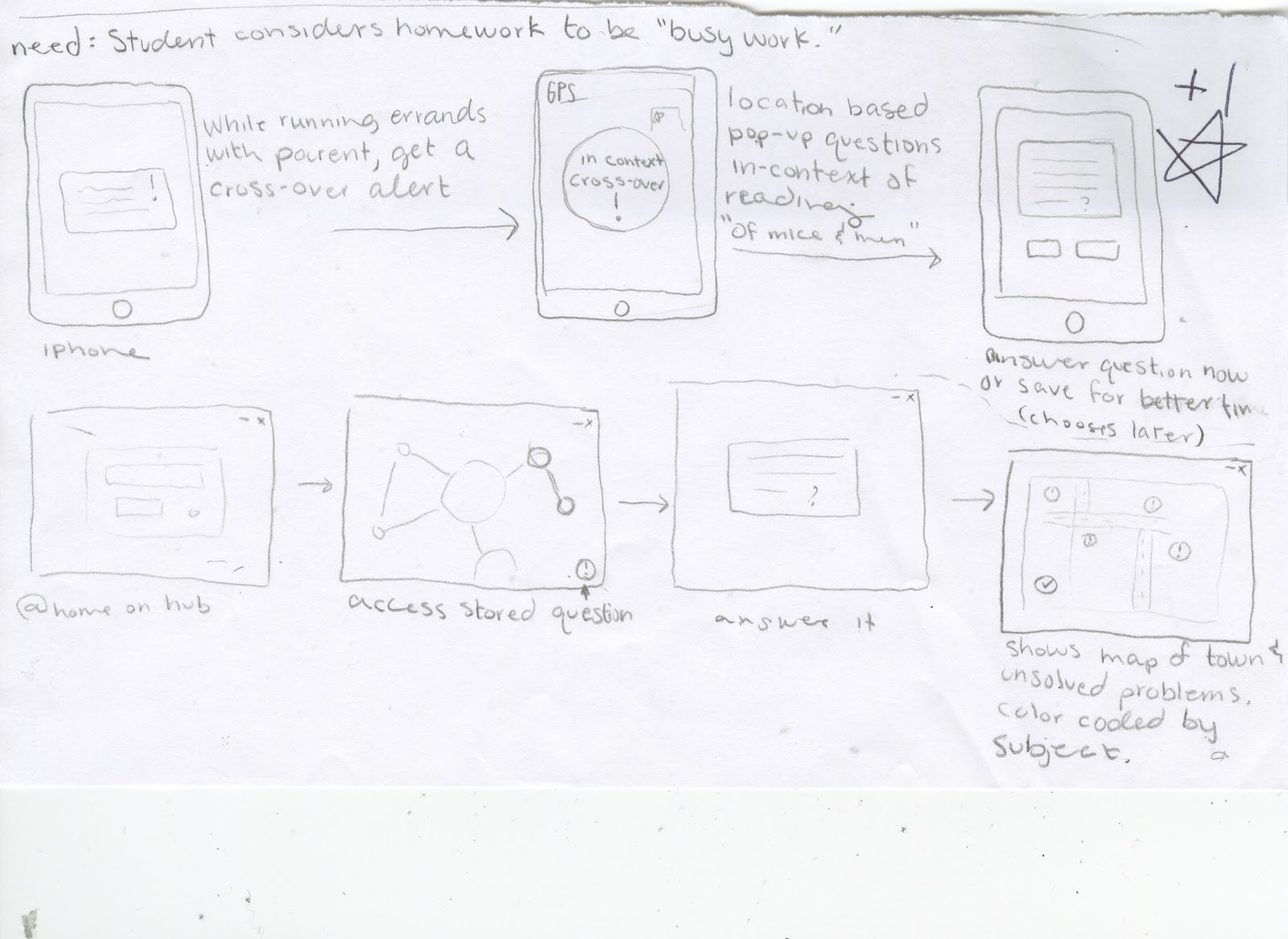
Class crossover is a predominantly after-school online community through which students of a single school, ages 11-14, can discuss the knowledge they gained with other classmates learning other subjects—breaking the boundaries of traditional education through integrating curriculum adds context and breadth to their education, while promoting participation, analytical thinking, and discussion.
Class Crossover
Students in this class crossover education model have school split into the in-class work and then after-school work. After school is where the online community aspect comes into play. Instead of homework, students would use something similar to a message board to connect the topics they discussed in class. They would participate in both synchronous and asynchronous sharing with other students(of all grades, but within their school) to connect the subjects. This way there is added insight, perspective and analytical thinking. Newly learned information can be called up in-class for more discussion. This subject-sharing would also give teachers a way to see where there might be some weak links in the curriculum.
PHYSICAL BOUNDRIES
In one school, and at each students home
WHAT’S AND WHO’S INVOLVED
Middle/Junior high students
Teachers
EQUIPMENT INVOLVED
home computers
internet
(perhaps) video sharing/camera function
(perhaps) scanner (for sharing notes and documents)
printed media and textbooks
digital-format textbooks?
***LOOK UP DIGITAL TEXTBOOKS IN SCHOOL***
DEMOGRAPHICS
11-14
able to afford OR check out computer/laptop (or tablet?)
all genders and races
WANTS AND NEEDS (INDIVIDUAL AND COMMUNITY)
individual:
want to be social
willing to discuss
self-motivation
open-minded
critical thoughts
community:
draw connections
desire for in-context subjects
need for relatability
need to make links
long-term retention
SYMBOLS
message board icons/conventions:
speech bubbles
plus signs
avatars
online identity
profile
memes
media references
signatures
group/guilds
polls
instant feed?
links (IMG, URL, VIDEO)
clubs
badges?
MOTIVATIONS FOR PARTICIPATING
part of grade
better retention of knowledge
confidence/empowerment through sharing
ability to discuss, rather than introverted learning
casual setting, comfortable
practical, well-rounded education
keeps kids connected, even outside of school (NO isolation!)
Katherine McCoy, you make me aware and uncomfortable.
From this reading, I gathered that apathetic designers are the professional equivalent of a prostitute. Steady, reliable service with an objective, removed point of view. This was an interesting read as it was an eye-opening article about the importance of creating design with a bias. Instead of being universal, it creates a more meaningful message because of its passion.
If this class it based on this article, I am both excited and apprehensive about what we will be doing. I, of course, have things that I have very opinionated about. But expressing those opinions publicly, and even worse, loudly, is something that I have been taught from an early age to not do. That's not to say that I'm stubbornly against being active and concerned, but rather that it might not come naturally to someone inclined to feigning apathy.
In a quickly changing digital society, this video gave great insight into the leaps and bounds that the web has made in such a short amount of time. Separating form and content, even the most techno-phobic individuals can have their own custom space and identity on the internet, no coding required (on their part, at least). What interested me most about this video was not the technological wonder of all of this mass exchange of data (even though that's crazy cool), but how from a cultural perspective, this relatively new "language" of the internet (coding, I guess) is like a Rosetta stone for connecting people of all ages, opinions, and areas into one huge online community.
Changes in technology have led to a huge change in how we send, receive, and perceive information. Everyone who is connected to the web can collect and contribute their own stories, and this is changing everything we have to deal with. We now have limitless sources to draw from, spanning over multiple channels, which are not redundant but rather complementary. Exploiting multiple channels helps to insure that the largest audience can receive (and potentially share) the information that you delivered.
Technology is allowing us the opportunity to branch out into new social possibilities. The open communication that is available is really leading way to more opportunities for creative expression and exchange between individuals. Mimi Ito hopes that this new media will continue to seep deeper into our lives, particularly finding its way into the learning process in schools. Some teachers are already beginning to adopt this social media as tools in their teaching toolbox. Now the challenge is to adapt their curriculum past the basics of subjects.
This was one of the most stimulating videos, in such a way that I'm not even sure what to say about it. While it was all very informative and relevant, it seems like one of the most pressing issues is the cyclical dilemma of the anaesthetic state that many of today's youth are in. Some of my feelings about all this are pulled more from my personal experience at my past schools than the video, but it all rolls together.
At the schools I went to, saying that the arts were neglected would be an understatement. I feel that this might be true in most schools. In elementary, we are taught to color and draw and explore and grow, but by about 4th or 5th grade, that interactive, creative form of learning was replaced and discouraged in favor of reading from a hefty stack of textbooks. While I might have been getting a heavy dose of dense information, what I wasn't getting was stimulation. Cutting children off from the media around them is meant to be in their best interest, I understand, but it is obviously taking a toll on the quality of their learning. Instead of removing them from the technology-rich environment of today, the real solution seems to be to adapt the technology to help them learn, and emerse them in it. The stimulation and inspiration of new ideas can only lead to more new ideas. Sir Ken Robinson touches on the concept of divergent thinking, or the creative ability to be able to come up with many non-linear answers to one question. Learning in the classroom needs to be more collaborative, more open, and more diversified to suit individuals learning styles.
Film as a second language. Media as a new language/viable source of education.
Being media literate is something that should be crucial to today's kids, since they are completely surrounded by this new form of education that, unfortunately, is not widely recognized in most schools. This video show several schools where technology is an integral part of the classroom, and where children not only learn about their subjects, but analyze it to better understand why it is important. Rather than just regurgitating information, they help to create it. Sounds like a cool system.
The web is smart. Really really smart. From what this article is saying, it seems like the need for keyboards and mice are beginning to fade away in favor it mobile devices and textless (like speech and location recognition) interfaces.
Some of this article seemed to be a bit over my head, but the general idea that I got from it is that the web is growing in wealth of knowledge through algorithms and applications that continue to allow it to cross-connect information and sort it in the most useful way for us. It can remember your interests, your searches, your location, many things about you to help set you in the right direction for whatever you're on the internet looking for. Even though it is intuitive though, it's not "learning," but "being taught." In other words, we are still the ones that have to feed it the information that it uses to grow with, it can't form this information on its own.
Every child falls into one of seven different intelligence types. Instead of teaching the child to learn in the format that works for you, it is most to the child's benefit if you learn the method of learning that best suits them. While this seems really cool, it also seems like it would be very difficult for this system to for in the traditional sort of school that kids are a part of currently.